
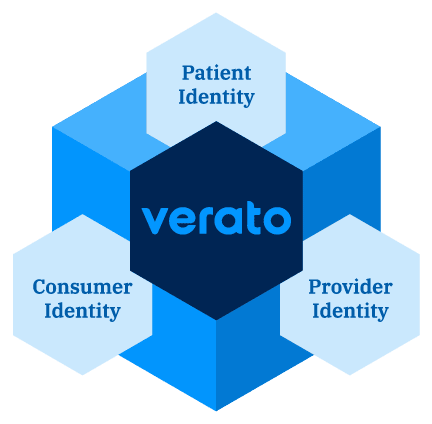
Verato solutions are powered by our industry-leading Verato Universal MPI™, a next-generation EMPI used by healthcare organizations to ensure accurate and complete person matching. Whether you manage data for patients, members, consumers, or providers, our integrated technology delivers highly precise identity resolution—giving you a trusted, 360-degree view of every individual.
What is EMPI in healthcare?
An Enterprise Master Person Index (EMPI) is a healthcare identity system that links and reconciles records for the same individual across multiple applications, ensuring organizations maintain accurate, complete, and consistent person data. Unlike basic MPIs that match records within a single system, an EMPI connects identities across EMRs, CRMs, claims systems, and analytics platforms, supporting a unified, trustworthy view of each person.

What is an EMPI used for?
Healthcare organizations use an EMPI to reliably match and connect identity data across siloed systems, including EMRs, CRMs, public health databases, and payer platforms. Because so much healthcare information depends on accurate identity, an EMPI is essential for managing data across a complex ecosystem.
What is an example of EMPI?
The Verato Universal MPI™ is a leading example that powers Verato MDM Cloud™ and all Verato solutions. It links records across disparate systems and ensures that identity data is accurate, consistent, and complete.

What is the difference between MPI and EMPI software?
MPI systems match records within a single application using basic algorithms. EMPI systems match records across multiple applications using more advanced logic, providing a broader, more complete view of an individual.
Choosing the right EMPI solution
Healthcare organizations have unique data workflows and business challenges. Your EMPI solution should be purpose-built to complement your ecosystem and support your strategic objectives.
Consider a cloud-native SaaS solution, for easy integration with all of your source data systems, seamless updates, and the ability to scale with your growing digital ecosystem.
Security breaches are a serious risk for healthcare organizations today. When partnering with any vendor, uncompromising data security is an absolute must. Only vendors with highest levels of data security should be considered, including HITRUST and SOC2 certifications. Features to look for include continuous threat monitoring and data encryption at rest and in flight.
Deploying an EMPI will be critical to the success of your strategic priorities–including smarter growth, better care, and actionable insights. You don’t have years to wait for results, so your EMPI should be easy to implement, require minimal or no tuning, and be useful out of the box without expensive professional services work.
More than in any other industry, the stakes are high in healthcare organizations to be sure fragmented records are matched accurately. Verato is truly unique in the market with our native Referential Matching technology, and is third-party verified to have industry-leading accuracy.
Consider an EMPI that is part of a larger data management platform, for one single source of truth for identities across patients, members, consumers, and providers. A comprehensive platform will scale with your organization’s needs while supporting a streamlined and efficient technology infrastructure. Verato has built the industry’s first hMDM platform–master data management reimagined specifically for healthcare use cases.
How does an EMPI work?
An EMPI links identity records by assigning each individual a unique identifier and connecting their information across systems using patient matching algorithms.

Patient matching algorithms
Patient matching compares demographic data to determine if two records belong to one person. Errors, missing information, and inconsistencies make this process challenging.

The Verato difference: Native Referential Matching
Verato combines probabilistic algorithms with a curated demographic reference database to dramatically improve matching accuracy—even when source data is flawed.

Resolving duplicate records
Duplicate records occur when multiple medical records exist for the same person. High-accuracy identity resolution helps identify and merge these duplicates.

Why duplicate records are a problem
Duplicate records lead to:
- Medical, billing, and claims errors
- Incomplete clinical histories
- Poor patient experiences
- Increased operational costs
- Redundant testing
Maintaining accurate, duplicate-free records is essential for strong analytics and safe clinical care.