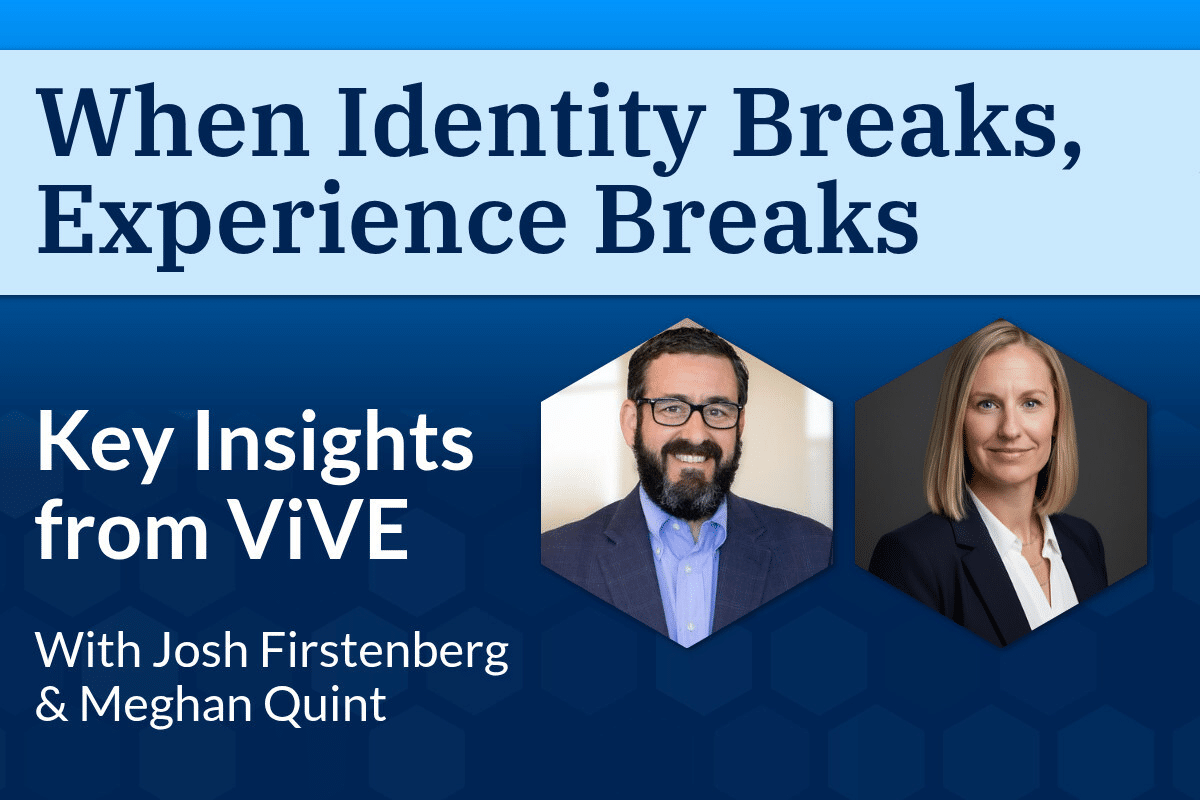
At ViVE 2026, Verato’s session When Identity Breaks, Experience Breaks featured a conversation between Josh Firstenberg, Sr. Dir., Partners and Customers at Verato, and Meghan Quint, SVP of Product & Customer Success at Opala. The discussion centered on a foundational issue that shapes every healthcare interaction: identity, and what happens when it fails.
Explore the full session recording here.
Why identity fragmentation breaks healthcare experience
Experience is often framed around digital access and usability, but those moments depend on something more fundamental — whether systems can accurately recognize and connect individuals.
“When identity breaks, experience breaks,” said Meghan Quint.
That breakdown shows up in familiar ways: duplicate records, repeated forms, and inconsistent information across touchpoints. These are not isolated usability issues. They point to a deeper problem with how identity is managed across systems.
When identity is inconsistent, every interaction built on top of it becomes less reliable.
How data silos in healthcare create daily friction
Patient identity fragmentation introduces friction across clinical, operational, and financial workflows. Teams spend time reconciling records, correcting data, and navigating gaps between systems.
“You see it everywhere, but you don’t always recognize it as an identity problem,” Meghan Quint noted.
Because these issues are distributed, they are often treated as routine inefficiencies rather than symptoms of a shared root cause. The result is cumulative drag that affects both staff productivity and patient experience.
Patient identity failures erode trust and experience
From the patient perspective, identity issues feel personal. Being asked to repeat information or encountering inaccuracies signals that the system doesn’t fully recognize them.
Trust is built through consistency. When that consistency breaks, confidence drops quickly. Patients may not describe the issue as identity fragmentation, but they experience it as friction and uncertainty.
AI and analytics depend on getting patient identity right
The conversation also highlighted how identity directly impacts AI and analytics initiatives. These capabilities rely on accurate, connected data to produce meaningful insights.
“If you don’t have a clean, unified view of the person, everything you build on top of it is compromised,” said Meghan Quint.
Fragmented patient identity leads to fragmented data, limiting the effectiveness of predictive models, personalization, and decision support.
Patient identity must be treated as a strategic healthcare capability
A consistent theme throughout the session was the need to elevate identity into a core, enterprise capability rather than leaving it confined to individual systems.
That means creating a unified, continuously trusted view of each person across all systems and touchpoints. Without that foundation, organizations remain constrained by the same issues, regardless of how many new tools they introduce.
The bottom line
Identity is foundational to both experience and performance in healthcare.
“When identity breaks, experience breaks,” Meghan Quint emphasized — a statement that reflects a broader reality: when organizations cannot reliably recognize individuals, every interaction, workflow, and outcome is affected.
Break the cycle of patient identity fragmentation
Learn how Verato MDM Cloud™ creates a continuously trusted, centralized view of patient identity — so healthcare workflows run smoother, data stays connected, and experiences improve.
Meet the experts

Josh Firstenberg is Senior Director, Partners and Customers, at Verato and an expert in business development and building connections that matter. He has more than 15 years of experience in master data management, with a focus on innovative healthcare solutions. Connect with him on LinkedIn or learn more about Verato at verato.com.

Meghan Quint is Senior Vice President of Product & Customer Success at Opala and an expert in healthcare strategy and data management. She has more than 15 years of experience in healthcare, with a focus on interoperability and digital transformation. Connect with her on LinkedIn or learn more about Opala at opala.com.