Can you tell us a bit about yourself and what you do at Verato?
Sure, I’m a 51-year-old Midwest guy. I grew up outside of Chicago and am originally from Detroit, a serial entrepreneur working for startups. I’ve had the benefit of working for three really successful startups, including Verato. I started my career as a consultant and applications developer. I held technical and project management roles in those companies, did pre-sales, account management, and ran services. Toward the second of those startups, I gravitated into more of a commercial sales role and eventually into sales leadership. I’ve been focused on this MDM space—master data management and EMPI—since 2003, which is the exact same age as my twin sons. So, they’re as old as my career in this space, which is kind of interesting.
I lead sales teams here at Verato across all of our multiple segments. I help our sales folks engage with prospective customers to identify challenges, understand their programs, and align our solutions. As we’ve matured, I’ve moved away from day-to-day support of market-facing teams and now focus on creating an environment where they and our sales leaders can be productive and solve problems for our customers.
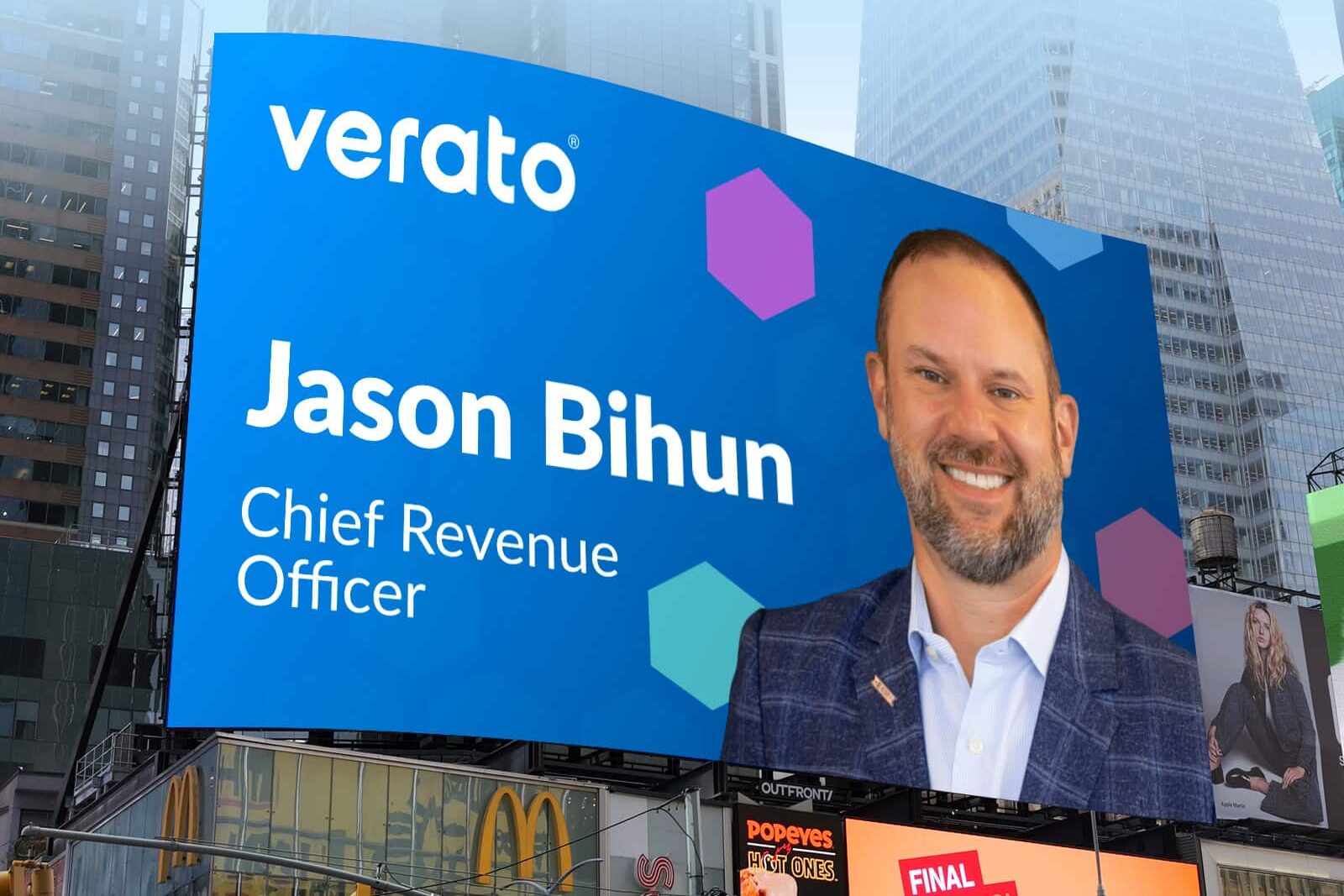
Verato’s message lit up Times Square. It’s a moment that reflects years of steady growth and leadership in identity intelligence. As someone who’s been part of that journey, what does this moment mean to you?
It’s a proud moment for me, and one that I’m really grateful for. I’m grateful to all of the folks across our nearly 200-employee organization who work hard every day to create opportunities like this. I fondly remember my first few days here, ten years ago, with Nick and Rachel and the commercial sales team playing foosball in an old dentist office that served as our workspace. Now we’ve gone from that to having a billboard in Times Square announcing our role in mastering data. I think it’s fitting—we solve gigantic problems and play a big part in helping healthcare and other industries meet consumer needs. Within the commercial team, there’s no doubt we can go out and help every company on the planet. It was a proud and fitting moment for us and for what comes next.
You’ve led Verato’s sales and revenue organization through significant transformation. What has driven that success, and how do you think about building lasting partnerships with customers?
It’s more simple than you think. The main driver for our success is that we solve real problems for our customers. That’s it. We continue to solve problems our customers are facing, and that creates an environment where they turn to us and have a positive working relationship with Verato. The revenue and sales success, and the growth of the company, are complete byproducts of that. It’s part of our culture to be customer-obsessed, and that’s evident in our ability to grow this company and work with innovative customers doing truly transformative things. That customer obsession is really at the root of our success.
Verato has become known for helping organizations build trusted connections, whether that’s patients and providers, members and plans, or consumers and brands. How do you see that mission playing out today?
The world is getting more complex. There are more apps, more workflows, more AI, more automation—and all of those rely on quality, trusted data to be productive. As the world grows in complexity, driven by consumer demand and experience, data becomes the fuel for success. Our role is becoming increasingly important: focusing on the underlying, foundational data that drives all that change, workflow, and automation. That aligns directly to our mission and to where the market is going.
You’ve watched the market evolve over the years, from early conversations about matching patient records to today’s enterprise focus on identity as a strategic asset. What’s changed most, and where do you see opportunity ahead?
A lot has changed—market dynamics, economies, and consumer behavior. But the most significant change, in my view, is consumer expectations. I can order a burrito, hail a car, or book a flight instantly on my phone. People expect instant gratification and personalized engagement from companies. They also expect those companies to know their preferences—for example, whether I like chicken or steak in my Chipotle burrito. Consumer expectations, especially in healthcare, are driving major shifts in how organizations engage. Companies are trying to master not only patient data but consumer data, and to understand consumers’ relationships with providers, organizations, and locations. In this complex world, getting a handle on all that data is imperative. To meet expectations, you must know who your customers are, what they prefer, and how they connect with others in your ecosystem. That’s the most significant change.
You’re known for your focus on people, both customers and the teams you lead. What principles guide you as a leader, and how are you shaping Verato’s culture of growth and connection?
That’s a really good question, and one I think about a lot. The guiding principle for me—and it’s a bit of a nod to Simon Sinek—is empathy. Organizations and companies don’t exist as entities; they’re collections of people. When people are aligned to the right objectives and mission, they need leadership through empathy. We all have lives and challenges, and at the end of the day, if people are participating in this organization and contributing to our mission, we have to lead with empathy. Everyone is capable; no one is a finished product. We just need to provide the right environment, counsel, coaching, and resources for people to be successful. Naturally, people want to do well—and empathy helps them get there.
Watch the video: